
You Can Ask What a Ritual Means
You do not have to choose between joining silently and rejecting an unfamiliar ceremony. There is another possibility: ask about one part.
Traditions & belonging · 13 min read
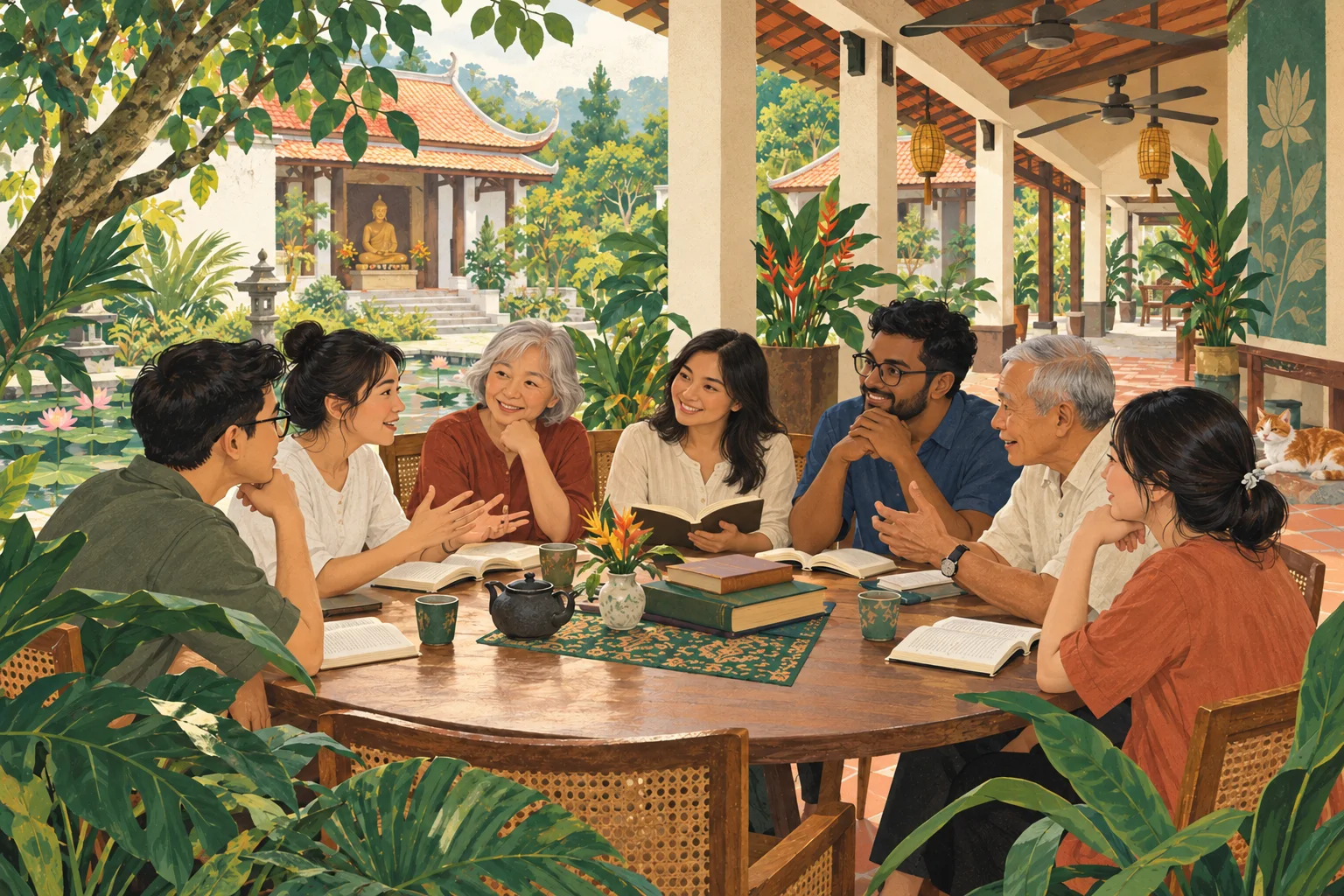
Shared foundations, honest differences, and a serious proposal for the next generation of Malaysian Buddhists.
A newcomer can walk into three Buddhist centres and wonder whether they have entered three different religions. One gathering chants in Pāli, another reads a Chinese sūtra, and another uses Tibetan prayers and unfamiliar images. The robes, calendars, gestures and explanations may differ. Even the words Dhamma and Dharma can sound like separate subjects before someone explains that they are related Pāli and Sanskrit terms.
Confusion is understandable. It does not, by itself, show that Malaysian Buddhism is divided or in crisis. Nor does visible variety tell us whether a community understands its own practices. A ceremony can carry thoughtful devotion; an apparently modern discussion can repeat unexamined assumptions. The useful question is what happens next: does a newcomer receive a patient explanation, or an invitation to judge another community before understanding it?
My concern comes from my involvement in Buddhist youth, media, Dhamma education and community work, including Ti-Ratana. I have encountered sectarian attitudes among some older practitioners, and younger people who seem less concerned with labels but unsure how the traditions fit together. These are my observations and aspirations, not findings about an entire generation. I want to examine a stronger shared Buddhist identity—and even the possibility of a unified tradition—without treating either elders or young people as a single kind of person.
A tradition is an inherited body of teachings, practices, texts and ways of transmitting them. Theravāda and Mahāyāna are broad historical families, not individual clubs. Vajrayāna names tantric Buddhist approaches usually situated within Mahāyāna, particularly in Tibetan Buddhism; placing all three in a comparison is useful, but they are not three neatly separate boxes. There is substantial diversity within each.
Cultural expression includes language, music, clothing, architecture, food and customs through which religious life becomes familiar. Institutional identity concerns a particular temple, association, lineage organisation or registered society. These overlap with tradition, but they are not interchangeable. Speaking Chinese does not determine everything someone believes, and an English-language programme does not automatically stand outside tradition.
A sectarian attitude is different again: dismissing people because of their affiliation, caricaturing their teachings, or using loyalty to justify contempt. Commitment to a lineage is not automatically sectarian. A teacher can explain why a doctrine is not accepted in that lineage without insulting those who accept it. We need room for principled disagreement as well as friendship; otherwise “unity” becomes a demand to stop thinking.
Existing cooperation challenges any simple picture of isolated camps. The Malaysian Buddhist Consultative Council lists organisations associated with different traditions. YBAM describes its work across Theravāda, Mahāyāna and Vajrayāna, including education, leadership development and publications in English, Chinese and Bahasa Malaysia. These are institutional descriptions, not evidence that every member agrees or that newcomers always feel included. [MBCC; YBAM]
Scholarship also complicates the idea that inherited religion is merely ritual without learning. Guan's 2021 study describes the development of Chinese Buddhist education through monastic, lay and social education. Tan Lee Ooi's 2024 chapter examines a particular university Dharma class in Malaysia, including undergraduates teaching juniors. Its published abstract presents youth as active transmitters of Buddhism, not simply passive recipients. This is a local ethnographic case, not a national survey. [Guan, 2021; Tan, 2024]
The sources consulted here do not establish a nationwide age gap in sectarian attitudes. We cannot turn a personal encounter into “older Buddhists divide us” or “young people have moved beyond sects.” Language, family history, education, locality and individual experience may matter alongside age. A useful future study would ask comparable questions across communities and generations, including less active participants, rather than recruit only people already enthusiastic about unity.
The document commonly called Basic Points Unifying the Theravāda and the Mahāyāna deserves careful reading. In his later essay One Vehicle for Peace, Walpola Rahula recalls presenting a formula at the request of Pimbure Sorata Thera at the World Buddhist Sangha Council's first international congress in Colombo in January 1967. He reports unanimous acceptance. His 1981 restatement is longer than the familiar nine-point version; the two should not be silently treated as identical. [Rahula, 1981]
The shorter text affirms refuge in the Triple Gem, the Four Noble Truths, dependent origination and cultivation towards awakening, while acknowledging differences in observances. Its wording about the bodhisattva ideal is stronger than a vague appeal to be kind. This was a significant council agreement, not a worldwide referendum or a merger of canons, ordination lineages and institutions. It offers a precedent for articulating common ground, not permission to claim every Buddhist accepts every formulation in precisely the same way. [Basic Points]
Shared foundations can be taught with that honesty. Generosity, ethical restraint, mental cultivation and wisdom connect Buddhist learning to conduct. The Four Noble Truths concern dukkha, its origin, its cessation and the path; the Noble Eightfold Path includes view, intention, speech, action, livelihood, effort, mindfulness and concentration. These are more demanding than feeling calm or becoming efficient. Traditions give these teachings different emphases and interpretations, but a beginner can learn their basic purposes without first mastering every philosophical debate. [SN 56.11; SN 45.8]
Scriptural authority is a real difference. Theravāda centres the Pāli Tipiṭaka and its interpretive traditions. Mahāyāna accepts additional sūtras and develops distinctive accounts of the bodhisattva path; Chinese and Tibetan collections are not identical. Vajrayāna involves tantric texts, transmission and specialised practices within a wider Buddhist path. A common introductory course should identify a text's source instead of labelling every passage simply “what Buddhism says.” [FPMT; BDK]
The arahant ideal is prominent in Theravāda, while Mahāyāna centrally encourages the bodhisattva aspiration to Buddhahood for the benefit of beings. That does not mean Theravāda lacks compassion or bodhisattva aspirations, or that Mahāyāna neglects personal discipline. Interpretations of Buddhahood, emptiness and the relation between different paths can differ significantly. We should explain positions in terms their practitioners recognise before evaluating them. Calling Theravāda “Hīnayāna” as a neutral modern label is inappropriate. [Rahula, 1981; The Ten Perfections]
Practice differs too, but meditation versus ritual is a poor dividing line: study, devotion, service and contemplation occur across traditions. Some tantric practices require empowerment, instruction and commitments. FPMT distinguishes practices that need initiation from some mantra recitation that may be open; permission cannot be inferred just because a text appears online. These are reasons for informed guidance, not a ranking of spiritual worth. [FPMT: Mantras]
Ekayāna, often translated “One Vehicle,” needs similar care. It has particular Mahāyāna doctrinal settings, notably the Lotus Sūtra's account of the Buddha's teaching and awakening. It is not a neutral administrative term for joining Malaysian organisations. Adopting it as a universal platform would already make an interpretive choice that others might not share. [Kubo & Yuyama, 2007]
The aspiration should not be reduced to a slogan about respecting differences. A unified Buddhist tradition could mean something substantial: a durable way of learning and practising together, transmitted to the next generation as a shared inheritance. But the phrase can hide three very different projects. We should say which one we propose and what authority it requires.
First, shared community: regular friendship, service, dialogue and mutual support across existing affiliations. People remain members of their own communities while recognising responsibilities to other Buddhists. This is achievable without doctrinal agreement on every point. It still requires work: shared decisions, fair use of resources, language access and mechanisms for resolving disagreements. A photograph of several robes together is a beginning, not the whole achievement.
Second, a common introductory curriculum: a jointly developed foundation in Buddhist ethics, key teachings, sources and literacy about traditions. This could help someone move from a family temple to a campus society without feeling that everything previously learned must be discarded. It could also teach people to recognise when a speaker is expressing a shared principle, a lineage interpretation or a personal opinion. Teachers would retain the freedom to explain differences and offer deeper study.
Third, a formally merged tradition: agreement on authoritative texts, doctrine, ordination, rituals, teacher recognition and governance. This would be much more than a shared syllabus. Who could authorise it? How would nuns, monks and lay practitioners participate? What would happen when inherited commitments conflict? Who would protect smaller language communities from being absorbed into the preferences of the largest institution? A new name would not answer these questions.
I find the aspiration to a shared living tradition worth pursuing, especially through the first two forms. A formal merger remains an open proposal to examine, not an accomplished fact or an inevitable next stage. It could promise clearer identity and easier movement between communities, but it could also produce a new central authority, a reduced curriculum, or one more school claiming to transcend all the others. Participation would need to be voluntary, with dissent treated as a contribution rather than disloyalty.
A shared Malaysian Buddhist identity could provide a hospitable first answer to “where do I belong?” It could name our responsibility to learn together in the languages people actually use, serve neighbours and welcome people whose family background differs from ours. It need not replace being a Theravāda practitioner, a Pure Land devotee, a Tibetan Buddhist student or a person still exploring.
It should also remain open to international visitors and resist equating Buddhism with one ethnicity. “Malaysian” describes the setting and shared civic responsibilities, not ownership of the Dhamma. Nor should English become the supposedly neutral language while other languages are treated as obstacles. Meaningful English, Malay and Chinese access means complete explanations and opportunities to ask questions, with other languages supported where communities can sustain them.
Preserving inheritance means more than keeping decorative features. An elder may know why a memorial ceremony matters to a family; a younger participant may notice that its explanation is inaccessible. Those insights can improve the same event. An organiser might provide a translated reading sheet, explain one practice before beginning, and invite questions afterwards. No one needs to abandon a meaningful ceremony for understanding to increase.
Ti-Ratana informs my perspective through my own community involvement; it is not being enlisted to endorse this proposal. Its public welcome describes centres bringing children, youth, adults and seniors together through education, youth activities, welfare and community service. That documented combination offers a useful setting in which to ask how learning, belonging and service might reinforce one another. It does not prove that a unified tradition has been established. [Ti-Ratana Buddhist Society, 2020]
My interpretation is that shared work can create opportunities for shared understanding. But helping at an event does not automatically explain the Dhamma. A short reflection after service could ask whose needs were met, whether volunteers were treated fairly, and how generosity relates to intention. A media team could pair a recording with an accessible summary and sources. These are proposals, not reports of particular conversations or official Ti-Ratana policies.
The Cunda Sutta warns against mutual disparagement between monks devoted to studying the teaching and monks devoted to meditation. Its immediate setting is monastic, not a modern Malaysian inter-tradition council, but it gives us a useful challenge: can we recognise a contribution we do not personally specialise in? Applying that question today is an editorial extension, not a claim that the text settles every doctrinal dispute. [AN 6.46]
Right speech also allows necessary correction. In MN 58, truth, benefit and appropriate timing matter; agreeable words are not the only permissible words. A community cannot call itself harmonious while making people afraid to report harm or ask difficult questions. Respect for teachers and elders should coexist with accountability. Younger leaders, too, need to explain decisions and accept correction. [MN 58]
A temple or campus society could pilot six meetings: the Buddha and Triple Gem; generosity and ethical conduct; the Four Noble Truths and path; attention and cultivation; an introduction to traditions; and a service activity with reflection. This is a suggested starting sequence, not an accredited syllabus. Ask knowledgeable teachers from the relevant traditions to check explanations of their own teachings, and make disagreement visible without turning a beginner session into a debate contest.
Give young participants responsibility in choosing topics, budgeting accessible activities and evaluating what helped them learn. Do not invite their opinions only after every decision is settled, or value them only for moving chairs and producing publicity. Pair that responsibility with support rather than expecting inexperienced volunteers to improvise expertise. Elders can contribute institutional memory, practical skill and questions of their own; age alone does not determine who teaches and who learns.
Keep participation affordable, offer accessible venues and readable materials, and explain time commitments in advance. For activities involving minors, establish appropriate supervision, consent arrangements, clear boundaries and a way to raise concerns with a responsible adult. These are practical proposals for care, not a claim that one checklist satisfies every organisation's obligations. A welcoming invitation should never require someone to tolerate pressure or secrecy.
Evaluate a pilot by asking whether participants can explain a foundation, describe a difference fairly and identify a trustworthy next step. Listen to people who stopped attending as well as enthusiastic regulars. Do not measure success only by attendance or social-media reach. If the programme makes people more confident in dismissing other Buddhists, it has missed its purpose even if every seat is filled.
The unity I hope for is strong enough to support a shared education and humble enough to acknowledge what remains unresolved. It would let a young person say “I am learning Buddhism” without immediately defending a camp, while allowing an experienced practitioner to remain deeply rooted in a lineage. We can test that possibility through actual teaching, service and conversation before declaring a new institutional identity.
A unified tradition, if it ever develops, would need to earn trust through those relationships and through serious engagement with its doctrinal and institutional questions. Meanwhile, a shared foundation is already meaningful work. We can explain what we practise, distinguish conviction from contempt, and pass on both knowledge and the freedom to ask. That is a future worth working towards together.
Rain Lee Lin Jun is the creator of The Middle Way and writes here from his stated experience in Buddhist youth, media, Dhamma education and community work. This is an independent reflection, prepared with AI assistance for research, writing, translation and illustration. It is not an official statement or endorsement by Ti-Ratana, YBAM, a university or any Sangha, and no monastic or scholarly review is claimed. Historical and textual sources support the points identified above; the organisational proposals and interpretation remain this publication's own.