Buddhism is more than a productivity technique
A quiet mind can sound attractive when the inbox is full. But if Buddhist practice becomes only a way to work harder without questioning the work, something important has been lost.
Buddhist foundations · 2 min read
Not every problem is solved by splitting the difference. The Middle Way asks us to look more carefully at the path we are choosing.
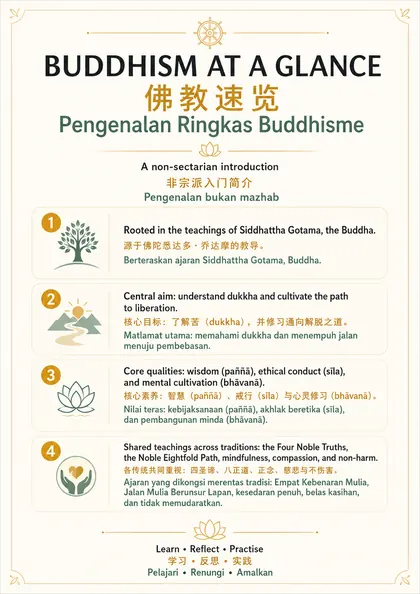
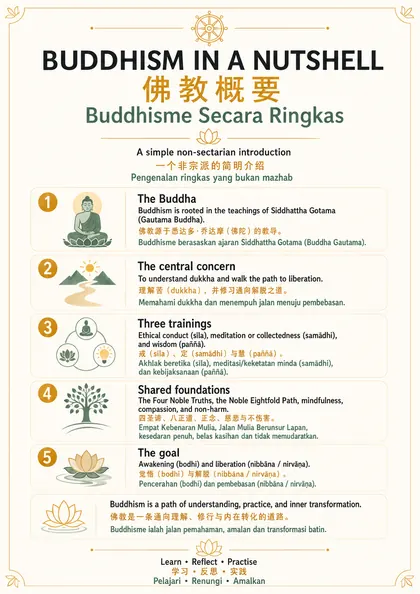
In the Dhammacakkappavattana Sutta, the Buddha describes a way beyond sensual indulgence and self-affliction and identifies it as the Noble Eightfold Path (SN 56.11). This is a specific account of spiritual practice. It is not a rule that every disagreement should end in a compromise.
Imagine a university group deciding whether to submit copied work. One member objects; another wants to take the shortcut. Submitting half the copied material would still be dishonest. The midpoint between two proposals is not necessarily a wise choice. This is a hypothetical example, not an account of the creator’s life.
The eight factors concern view, intention, speech, action, livelihood, effort, mindfulness and concentration. They bring understanding, conduct and mental cultivation together. We can begin by asking what we know, what we are assuming and what is motivating us. We can then consider who will be affected and which response is both truthful and responsible.
Sometimes this means a firm refusal. Sometimes it means listening because we have misunderstood. Neither stubbornness nor easy agreement is automatically wisdom. A response must fit the facts and the ethical situation.
A message arrives that annoys you. An immediate reply might satisfy the urge to win. Avoiding the issue indefinitely might leave an important problem unresolved. A pause can make room to check the facts, notice the intention behind the reply and choose a useful time to speak. The pause matters because of what follows it.
This application does not promise a painless resolution. A careful conversation can still feel uncomfortable. Nor does one calm reply complete the work of cultivation. The path includes repeated learning and the willingness to correct mistakes.
Before one decision today, ask: am I choosing this because it is wise, or because it ends my discomfort quickly? Then consider one factor of the path that could guide the next step. The Middle Way does not ask us to abandon principles. It asks us to examine how we live by them.
A quiet mind can sound attractive when the inbox is full. But if Buddhist practice becomes only a way to work harder without questioning the work, something important has been lost.